Sometimes I struggle with anger. Fury that multiplies and rises like a firework that once set is a ricochet of clattering. I get so frustrated by all the little things and I can’t hold back any longer. I explode. I believe it’s important to be authentic and to let ourselves feel what we are feeling, to let it out. But and also, I believe in the cultivated safe space of a mother, the learned patience to let it go, to not let my emotions spin me out into bursts of rage, particularly if my little one is any where around.
Sometimes I blame it on my liver and all the abuse I put it through in the years of attempting to drown out the feelings that needed to rise like fire all the same. Like a hot pit of coals with dried brush tossed on top taking an already heated situation and bursting it into flames. I simmer and seethe.
Sometimes I blame it on my hormones. It’s the cortisol spikes in my progesterone phase. I meant to reduce all stress to a minimum and now everything is happening all at once and I’m weeping and cramping and feeling like I can’t ever take good enough care of myself. I’m so tired. I just want to stop.
Sometimes I blame it on the culture. The patriarchy. The capitalism. The generations of pain that spread out in their own wildfires taking so many bodies and families and stories with it. I want to save the future from it. I want everyone to just stop.
Sometimes I blame it on epigenetics, the blood in my veins, the rip I still feel from when my ancestors left where-ever was the homeland in an attempt to make somewhere else home and they couldn’t run away from themselves, their history, their pain but instead drag a trail of ashes and embers burning everything up just the same.
I crave landscapes that saturate some indescribably parched piece of my soul. I crave the stories and the wisdom that live in those places.
All the time I crave water. Gulping it down, dousing myself, standing in the shower waiting patiently for when I finally feel supple again. I spritz my face with rose water and rub in a serum thinking maybe this can help stop the evaporation. I spread balms across my skin. I add trace minerals into my water bottle and hope this might fully hydrate my mouth. I drink and spritz and swim and gulp and sigh and wait and swallow and I still feel the desert at my core. The little creature in me eager to be in its right environment.
When it rains in Colorado, I could melt. All of me spreads out and every pore in my body takes a deep inhale. I could cry but can’t waste the tears. I am cooled.
It’s a misting rain and I feel closer to home than I’ve ever felt like standing in a boreal forest. I swear I can smell salt on the air. Suddenly, the trees feel more familiar like I’ve known them for longer than time and the bird song echoes out in a net that holds me tenderly. The breeze kissing my brow and I feel calm again.
Sometimes, a lot of the time, I think about leaving. I think about living somewhere else. And I know wherever I go, it’s still just me. And these gentle reprieves help me endure. I don’t want to live a life enduring. No one does. No one should. Unless enduring means persistence and less of the suffering. And so I shift my perspective, I use the word with a different lilt.
Suddenly, enduring is supple. Enduring is always present. Enduring is sensual, alive, and forgiving.
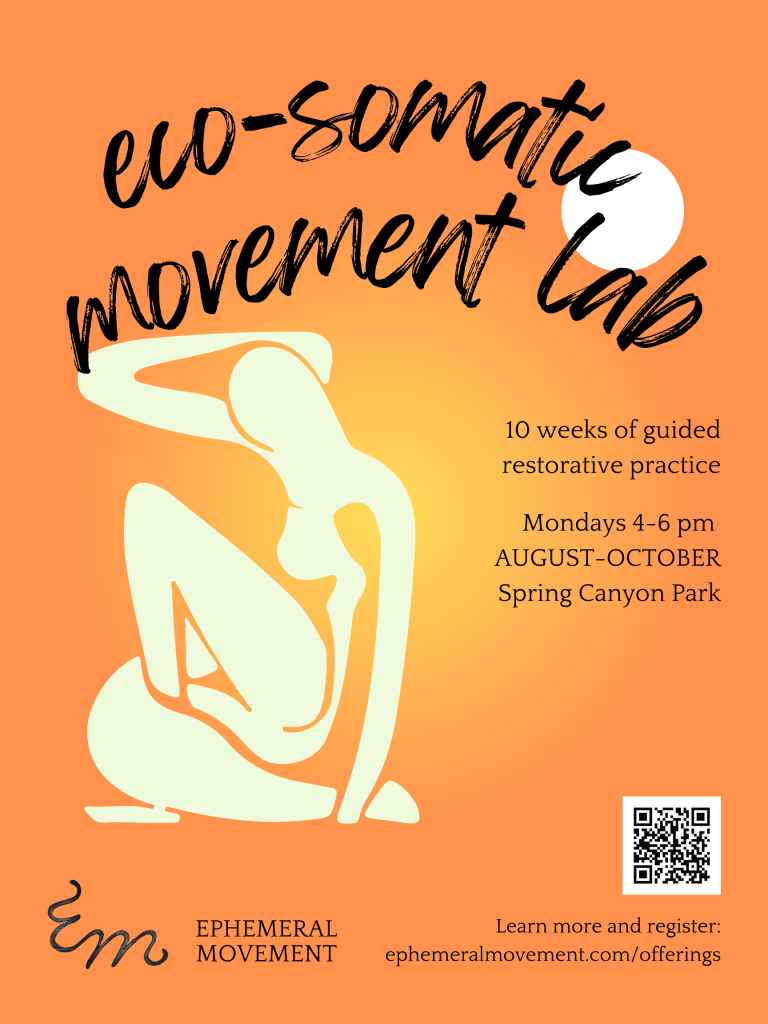
This August I’ll be offering a 10-week Eco-Somatic Movement Lab based on the principles of Ephemeral Movement. This will be the first time I’ve ever offered a comprehensive experience of the epistemology of my work. Each week we will be covering a different core theme of Ephemeral Movement.
Classes will be facilitated in a group container with guided meditations, exploratory somatic movement, and creative expressive practices to process the work. No experience is necessary to join. The aim is for each participant to walk away with not only a deeper sense of self, place, and inter-relational growth but practices and experience to keep exploring.
Classes will be hosted outdoors in a local Fort Collins park with access via the bike trails or by car and sidewalk. It’s suggested to be prepared for outdoor work with sunscreen, water, comfortable clothes, a meditation cushion or pillow and/or blanket, a lawn chair if needed, or whatever will make the space most accessible for you.
For more details and to register, toggle over to my Offerings page. Please, reach out with any questions.
With a digging fork, a dog, and a toddler, it’s spring and I’m haruffing and puffing my way down nearly 300 feet of dye bed rooting up dandelion in an attempt to “waste naught want naught”. Working hard against the compact soil, I’m having some full-body recognition of things I would have done differently for the dye plants and space. I would have cultivated, mulched, covered, cut back seed heads before they dispersed, harvested roots in the fall, etc etc etc. If I had less distractions and more freedom in this moment, I would have saved back the dandelion flower heads and buds for other tasty affairs, but alas, it was just about the root for me. And while I in no way got through that entire 300 ft, I did walk away with a crate of dandelion root still attached to its aerial parts to be processed and plenty of thoughts about the state of things.
Aside from the exorbitant weeds, I was taking witness to the chaos of my unsystematic approach to being gifted such an expanse of space. And my self-talk was not so shiny. Partly, looking at the life of a plant bed in early spring will typically not be very clarifying of what’s to come as far as bounty feels. It’s easy to cling to the mess of what it looks like and not see ahead to the vibrant multiplicity of summer. Now that we are in summer and I’ve already picked my first flush of dyers chamomile while many of the transplants are growing taller than the weeds, I’m feeling both relaxed and eager to keep my wits about me this time around. I ride the train of improvement pretty hard sometimes; I’ll start seeing all the ways I could have done better. Other people will see this as being regretful. And sure, there’s some regret, but it’s mostly about how I might make better choices next time that are aligned with the outcome I want. It’s the way I’m designed. I love improving systems and my self in the process.
After I exhaled a great deal of “this should be better” onto myself. I also gave myself some grace. Last year, I was in my first full year of motherhood. I was grateful enough just to have harvested the amount of plant material as I had AND even hosted a small class. I didn’t get to play with fermenting the indigo we grew, but I did dry back and powder a bunch to play with later. Oh yeah, and I dyed flags with the material we grew for our wedding that made hundreds of feet of flag banners (as well as 5 ties for the wedding party). I have ample amounts of plant materials to play with this year as I grow the next bulk.
Grace has been a theme word for me this year. I’m offering this word up whenever things get tough. I offer it to myself. I offer it to others, loved ones, strangers. It feels like an exhale and a loosening and a lightening. We all have our burdens, our habits, our labors that we carry, that tangle up between us when no one is paying close enough attention. When we give grace, we give each other that attention, that recognition and witnessing that detangles the moment.
So I offer myself this grace as I slag my way up the weedy mess of a bed and laugh at myself. I’m embodying the learning of how to grow these specific plants, how to harvest and dry them, how to make dyes and prepare the textiles. I’m learning all of this and simultaneously offering up what I learn in my classes with others. I’m learning how to be more kind to everything. I’m learning about learning and how essential it is that we literally embody the work.
We can think about things all we want, but until we actually try them on, embody them, they are just “ideas”, not true knowledge. If there is something you want to understand better, to learn, to know, get out there and just try. Do the work. Get into the process. The process is where the magic is. I’d argue that the process is the MOST important part of anything. In food we care about the growing practices. In relationships we care about how people show up in the moment. In play it’s about skill and gamesmanship, not about who wins. In art, I’ve come to feel that it’s the consciousness with which an artist channels while they work or perform that captivates us in the end.
In all things on earth, we should care about HOW it’s done. The final product is imbued with the process. It’s a type of magic that the capitalist mainstream culture will either have you forget or use as a strategy for your patronage. I’m not saying it’s wrong (the latter at least). I use it for my own small business because I truly believe that where and how things are sourced make up the magic of the final product and I love what I do. We vote with our dollar and I believe it should be spent as wisely as we are able. We all live in capitalism. The more we look it in the eye, the more power we have over ourselves in the mess. When we embody the knowledge of how our attention is aimed, is lured, we gain more control and have more choice. I think this also means we get more of our time back which is our most precious resource.
And I feel like I have to recommend that anyone who enjoys the medicine of dandelion root dig up, clean, and dry their own stock of dandelion for a year. It’s such a common herb that unless you’ve processed it yourself, you may not realize the work that goes into it. If your soil is nice and loamy it should be pretty easy. In Colorado, you should save such work after the soil has been primed by the rain or a sprinkler. And while typically harvesting roots is a fall endeavor, if you are weeding a space and it’s spring, don’t hold yourself back if the root isn’t mushy.
I harvest a full crate of dandelions. After processing down to the root, rinsing, and drying, I’ve got a quart jar of medicine to use. It’s a lot of work for a bit of material and an immense amount of embodied knowledge. This jar of root not only cultivated my capabilities but the contents are even more sacred to me because I did the work myself for my family.
Get into your process. Embody the learning. Enjoy it all along the way or at least laugh about the hard moments once you’re able.
The current astrology (eclipse season) has been telling me (and maybe, you, too?) to rest. It’s been advising me to clear out the excess in my schedule and prepare for unexpected delays. No one would have to try very hard to convince me to take it easy. I DO know I need a lot of rest. I have worked very hard at resting more because I have come to understand my own flow of action and stillness more thoroughly. When I am in “go” mode, I can accomplish in a few hours what would take other people days. Not to say I’m the fastest in the west or anything, though who knows, maybe I am. I am, at least, sometimes the most precise-in-action in the room. And if nothing else, I can have some really fantastic bursts of creative and motivated prowess. As for the current astrological sky, I know this important rest has to do with some new offerings in the works for Ephemeral Movement (among some other channels). I’ve got a very serious creative and logistical mountain to climb and it’s one step at a time. For now, this time is for dreaming it up, laying it out, and laying myself out to go as slow as I possibly can before I take to the proverbial trails and ascend this new, uncharted territory.
This space I’m cultivating for rest will see not only my projects, but my overall health and wellbeing through to the other side. With that, my creativity is protected so that it is able to flourish. I speak of creativity as an essential need in my life, and ultimately in yours, because it is what drives humanity to connect with the world around us. And it brings a special something to our souls. A common and untrue sentence that devalues our self-worth is, “I’m not creative”. I’ve heard plenty of people say this throughout my life. This is NEVER true. We are all innately creative. Skill-craft, dance, song, storytelling, art were all culturally entangled into the daily lives of humans before the industrial revolution. What differs is where and how we focus our creative energy. What differs is how much we have cultivated our creative skills. Problem-solving is one of the most basic creative actions, and all of us, every day, in all of our different skills have to use problem-solving to get through our work, our passions, our meals. Take creativity beyond it’s daily necessity for survival and we enter the realm of creative expression. This is the realm of open possibility. One thing holding us back is a mind closed to change, to transition, to the natural unfolding of discovery. Another thing in the way is all the do-ing.
Why, then, can rest be suggested as a doorway to creative expression? We need to slow down and reduce stimuli to get to an integrated place where we are experiencing our mediums fluidly. In our modern culture we experience nearly constant stimuli and stressors. Having a pocket device that is an alarm clock, a planner, a computer, a camera, a phone, a game system, our social exchange, and more, means we never truly turn off. Most people I’m around have their phone ringer on at all times, and many have app notifications set to alert them as well. My husband has reminder sounds–so I have to hear that he’s gotten a text twice, if not more times, when his phone, watch, and iPad are all in the same room. Personally, that would drive me insane (and, for the record, it does). My phone is mainly (not all) just that: a phone. I have my ringer off and only accept notifications from an astro app I enjoy the mindful reminders from. But even I struggle with picking up my phone and mindlessly checking my email or social media. Supposedly, the average American spends 4.5 hours on their phone a day (I heard teenagers spend upwards of 7 hours a day).
FOUR AND A HALF HOURS. That’s 2 movies. That’s a seminar. That’s probably meal-planning and making those meals for a week. That’s how many chapters in a good book? That’s how many hours of your vitality doing what? That’s definitely an entire sewing project making a pair of pants. Just imagine what you could accomplish if you saved up all that time for something that puts your creative brain into flow state? It’s an amazing amount of time. What if that was just four and a half hours of rest throughout the day; 5 minutes to spritz the face and do some light facial care in the morning to wake up, 10 minutes of watching the light change out the window while you drink your coffee, 20 minutes of lazy journaling, 20 minutes for an afternoon nap, 45 minutes reading a book after lunch, 20 minutes of doodling and daydreaming, 10 minutes sipping a cup of herbal tea, 30 minutes of stretching and 30 minutes of exercise, 30 minutes for a dreamy phone-call with a good friend, and 20 minutes to listen to some of your favorite music while you lay on your back in the living room. That’s 4 hours. That is a speed of life that I know so many desire. How do we get it?
Can we really just reach out and touch a slower life if we put down our phones and stop scrolling? But, and how? When we get such an immediate dopamine high from a device and we feel we don’t have a lot of time, it’s the easiest fix. When there is always a project, chores, work, or someone vying for our attention, how do we say, “no, thank you, not today”? And if you’re a people-pleaser, this is probably exceptionally hard for you. Can we compartmentalize our people-pleasing? Maybe if we acknowledge we aren’t very pleasurable when we are feeling foul from being exhausted or we’d rather be doing something else.
It’s simple to suggest that it would be easy to take that time we spend on our phones or completing some fantasy-of-importance task and turn it into rest. It’s an interesting experiment to attempt. I’ve read over 6 books in the last few months because I’ve been trying this out (reading is typically my right before bed practice and was replacing TV time). That’s a record for me in the last handful of years. Of course, there are seasons in life. What season are you in? Are you ready to embody a more creative life? I wonder how rest would help you do so?
The month of April is about going slow to gather energy for the next big, life-changing to-do’s of the year. Empty the calendar where possible. Take a little off the plate. If you’re joining in this practice my only advice is to breathe into your roots and root into your resting. Whatever that means to you.
The following is a practice to try.
Root into Rest Practice: Find a comfortable position, seated or laying down and take deep, relaxed breaths until you are naturally breathing comfortably on your own. Locate and elongate your spine. Envision there is a golden thread rooting downward through your pelvis into the earth and the other end is lightly lifting you up towards the sky, the top of your head floating effortlessly. Allow your tongue to sit relaxed at the top of your mouth, release any tension in your jaw and eyes. Breathe into this space you’ve created in your body. Imagine a golden, glowing light throughout and radiating outward. Each inhale you bring up through the earth and each exhale more golden glitter puffs out around you, dancing in the air like dust particles in the sunlight. Breathe like this until you and the space around you is well-dusted and immersed in the golden, glowing, glitter and you are comfortably rooted to this restful place on the earth. Be here as long as you like. When you feel done, take a few breaths to return to a more active body and witness the space you are in. Look around at it, releasing your head and body back to a pedestrian state. Maybe some toe wiggles, shoulder rolls, head tilts. When you’re ready, you can get up and go about your day taking this restful moment with you.
Often, I think about the importance of “not-knowing” and considering how much we can’t conceive. It’s become common that we give away our power to scientists, doctors, politicians, influencers, friends, family. There is value in years of experience that lead to professionals being top of their field. Or to the hard-fought opinions made facts that so many preach. Visionaries continue to question whether we really have all the information. And some of the most “out-there” people, way ahead of their time, receive guffahs to their “outlandish” ideas. Most of the time, we don’t have all the information. A lot of what we take in as truths are just agreed upon results for the time being. It’s all subject to change when our capacity for understanding shifts. And it’s all subject to who has the power. How often do we believe the experts and then decades later more information to paint a fuller picture is released and so we must shift perspective? It genuinely makes me laugh at how much of what is “real” is really just made up. And it makes me ache at how many of these “truths” were designed for power and control. I used to be gullible. Now I can hardly take anyone serious when they start speaking in absolutes.
Some would say that whatever you believe becomes true for you. If that is so, why not open to not-knowing, to having a magical sense of unknown and the potential for fantastic possibilities. This is part of what can be difficult neurologically for survivors of trauma (and anyone living under capitalism, patriarchy, and colonialism, but that’s a whole other thread, though entirely relatable). The brain is wired for survival and when something intense happens, our brains learn from and wire to respond with the previous evidence of threat. This is useful if the threat hasn’t passed, but when it’s long gone and your nervous system is constantly reacting to minor inconveniences and non-threats, it can become exhausting. When fear is what the unknown kindles in us, we can struggle to want to lean in.
I experience this is my life more recently when I’m tagging patterns in people who have hurt me and finding evidence to prove my feelings right about how this person is wrong. I’m thinking I can’t forgive them unless I lay it all out and explain the rage, detail their missteps, and find some vindication through their acknowledgement. But, I struggle to find the courage to even mention to them how it hurts and instead continue my internal narrative. Unable to really forgive and too cowardly to hurt their feelings with my truth, I walk a fence-line of discomfort and feel invisible. Unable to change the person as they are or my feelings about them, I repeat my frustrations to myself and sometimes other willing ears. Being witnessed helps me understand myself better and while it may not change the situation or my feelings, it helps to release the pressure building up within me. It allows me to rewrite what is happening from a more realistic viewpoint, less vindictive, more understanding for the other and myself. While my authentic feelings may be difficult they are not static. I can go from the rage of disbelief that aims to protect me to a calm understanding of why those feelings have arisen. This is powerful witnessing; whether with a journal or a friend, reflecting on the how and why helps me move past the what and who, transforming fear of the unknown into possibility.
Luckily, our brains are malleable and trainable. Thoughts and words repeated alchemize into truths. “I am loved and safe” might not feel true for awhile, but eventually the somatic tuning of the body shifts and one day, it’s not only true, but it feels true. I may repeat to myself, “I can uphold boundaries and build clarity with a kind firmness” many times before I actually speak anything into being. I have to rewire my self-talk around being a push-over or being unable to speak my truth. “I can be kind and firm”. “Being authentic helps others be authentic, too”. “Conflict does not equal endings”.
Through simple thought practices, we titrate our way to healthful self-talk, healthy habits, and more connectivity to ourselves and the world around us. When we are not in a amygdala-based, reactive fight-or-flight-or-fawn state, we can open up to the vitality of nature–within, outside-of, and all around us. We expand our capacity for engagement through practice. Capacity to sense our physiological needs, capacity for interacting with loved ones and the larger community, and capacity to sense beyond ourselves into our nature-self, the interconnected life-force of the world.
Anyone who works with plants will tell you how they communicate telepathically or how moon phases effect agriculture. There is so much that we can’t see. Have you ever slowly walked towards a tree in an “open” state and felt the moment you’ve entered it’s bubble? Try it. A few times if you have to. The same can be done with a partner or friend. Walk towards each other from 30 feet away. Pause when you need to. Retreat if that feels good. Go slow or fast but pay attention to the subtle energies at play. Aim to meet at least a few feet together. It’s a lot of fun and kinda intimidating at times. An excellent “ice-breaker” for groups, too. It takes practice to truly witness, to consciously participate and respond, and to remain non-judgemental. All space is shared space.
In shared space there’s a softness to hold and be held. There’s a magic in the witnessing, something about the other set of eyes, the nervous system and experience of the other individual(s) in the room that helps to bring meaning out of seemingly simple or even mundane moments. Being witnessed is no small thing. When we live or create without ever connecting or giving away or being acknowledged our work, thoughts, feelings, etc., remain in a vacuum. We are designed to share and be seen.
In Ephemeral Movement, not-knowing is key. The practice of showing up without judgement and the conscious agreement to participate, witness, and collaborate with anything that catches. Guiding through following and holding the not-knowing for the possibility of discovery. In essence; opening to not-knowing and moving through that opening into a more full and connected way of being. It is a practice, a skill, an ongoing effort to be and feel connected, vital, and collaborative.
Sending warmth and blessings on this time of spring equinox! May we all have the courage, tenacity, and compassion to move towards what helps us grow in this time of new beginnings.
When you read “empty space” what comes to the forefront of your mind? Is there a value set upon it? An emotional response? Disinterest? Curiosity?
I sit with “empty space” now and my experience is expansive. A deep inhale and a long, natural exhale brings me into my seat, the living room, at home. I begin to float and pour out of myself while simultaneously allowing the environment I’m in to fill me. Layers of buzzing in my ears from within and without. Light and shadows are more stark. Time expands and contracts. A dance of sensations and information about my current state and the space around. I feel tired. I feel calm. A scintilla of my responsibilities tug my chest downward. Another deep breath. Joy in my chest, and sorrow beneath my eyelids. Tears are just beneath the surface. My fingertips feel electric and my knuckles heavy. My sacrum glows yellow and my tummy aches. An interruption tangles up my chest with frustration. A momentary lament of the slow uncovering I had been in. I grasp at it. Anger rises. As a mother I get so little time alone; a choice I make consciously. Even still, it can be grating when you find yourself in a spare moment of solitude and are yanked from perceived peace. As the space settles again, another deep breath helps me return to this practice. I sit silently for a few minutes focused more on the space around me than the sensations of my body. Everything, while not “put away” seems to be in its right place. A plush mushroom in the walkway, house slippers astray, blocks scattered, an empty tea cup and a barely read book. An urge to get up and rearrange some plants in the window passes. I remain sitting here, computer in lap, leaned back on the couch, legs crossed and folded. I find myself at a pivot. I get up and go outside.
Like a blank canvas or page, an empty vase, or a task-free moment, space can open up to us with an invitation to fill it however we please. There’s a powerful moment of unknown–what will unfold? What will I do next? Rest? What do we want? What do we need? What does your body tell you to do right now? Maybe your body tells you to go outside or eat a snack or take a drink of water or lay on the floor and space out or to simply just be where you are. Oblige. Acknowledge and appreciate your inherent knowing. When we are able to connect to this, every place is right where we need to be.
Empty space is a contemplative practice, something that can be done at any juncture for any length of time. It’s basically meditation, it’s also not meditation if you need it not to be. It’s a somatic practice. It’s the practice of returning, letting the new moment take hold, and participating in that magnetism that draws us forward. It can be a single breath; the inhale rejuvenating and the bottom of the exhale spacious. Or the inhale a keying in to our physiological needs and the exhale an acceptance. I write this and my eyes glaze into peripheral seeing. I could take a nap. I’m also energized by just being. Thanking all grace given to this moment of “nothing” when it truly is something just to be, here, noticing what I notice; my needs met enough to pause for the unfolding. Does some part of your body call out to be acknowledged? Is there a color to it? Does it pulsate, flicker, glow? Does it change as you listen. Follow what grabs hold with a curiosity and sense of awe; there is an opportunity to witness without judgement.
Empty space and awe are partners. Awe is a key tool in participation. Does the spaciousness, the dancing sunlight, your heart pumping and lungs working not inspire you and bring you to your knees? Is it not painfully pleasurable? Every atom of ourselves mix with every other particle of the space around us. Allow space to fill you through your cells. Exhale yourself into the world with that unified awareness. All the hurt and joy in the world wrapped up in one mundane moment; empty space is never truly empty.
There’s going to be pain no matter what you do in life, whether through your own personal experience or from the experience of empathy and compassion as witness to the world. We must witness ourselves and each other. A dance of turning inward and outward again to cyclically anchor us to life, the realities whether harsh and unfair or privileged and soft. If not, we lose a very visceral and alive piece of our humanity. We are not as solid and separate as mainstream culture might suggest or train us to think. Do not go numb. Do not sever your heart so that it won’t hurt. Grief and sorrow are catalysts for change and beauty. Reach into the cavernous deep and discover how it can transport us to better beginnings.
Empty yourself into the ocean and let it fill you up again. Exhale yourself completely into the trees and let them fill you up again. Lean deeply into an embrace with someone and hold each other up. Be empty so that you may be full.
It’s March! Go outside and catch some sun before we get the last snows of the season.
Thank you for joining. If you haven’t yet and feel inspired, please subscribe! I am now offering individually tailored sessions in Fort Collins, CO on a limited basis. My facilitation style is meant to meet you where you’re at and help you build mindfulness skills to tune into your body and find support within and in the natural world. Stay tuned for group movement classes coming soon, hopefully *fingers crossed*.
Great loss can catapult us into positive change, an emptiness that lays like a blank canvas or a freshly dug hole in the earth. After many personal upheavals in 2017, I became ruthless with my space; clearing away anything that didn’t resonate. At the time, I even let go of the best job, housing, and community I had in my decade in Boulder, CO. It was difficult to walk away from those people and that glorious radius I’d found, but a deeper sense of living was urging me forward (and it’s taken many years of twists and turns to feel a baseline of being again).
I’m sure many of us can relate to the ease of collecting and the difficulty with letting go. Whether it’s kitchen tools, arts and crafts supplies, interesting trinkets, or opinions and reactionary emotions, we are the dragon in the cave who treasures anything that glitters and glimmers. Maybe we hope these things mirror something of us, who we want to be to the world, or perhaps showcase how we came to be the way we are. Whether it’s victimhood, righteous personhood, or a glorious overcoming of obstacles, we collect beautiful and interesting qualities that we wish to be recognized for, or feel we have no choice but to be. We get wired, rewired, and react. We grasp, hold, collect. Do you believe your worth is a reflection of your home or your strong viewpoints or your ‘higher’ education? Is your ego attached to your bed-sheets and the stories in the books on your shelf? Are you afraid of who you will become without that pair of shoes or your potted plants or your political concerns? How much thought goes into the space that fills your home? What IS home to you?
Home is an interesting concept. It’s definition is entirely personal. Home has felt like different things in the past, for me. Certain people, specific geography, even just a sense of connection and peace in my own body. At every age it can be varied and change. When my parents split up, I was 15 and that idea of a childhood home to return to dissipated. My father stayed in the house, but he didn’t maintain a home. Whenever I went back to visit, I’d be lucky if there was a clean bed or couch to sleep on. My things, whatever left, had been packed up or tossed out over time. It wasn’t that he wasn’t welcoming, he just wasn’t designed that way. Or rather, his life had been a series of unfortunate events as far as family and home were concerned. His baggage affected everyone. My mom was on the move, reclaiming her own sense of home. Redefining herself in the world after dedicating decades to their partnership and our family. I decided to move out as soon as the right opportunity arose. I feel like I was always in search of home and belonging. My 20s and 30s had been about reclaiming my body and my place in the world. Now, home is wherever I’m sitting. It’s when I’m with loved ones. It’s being outdoors. It’s moving creatively and freely in this body.
Sometimes, home hurts in other ways. Ecological grief is a generally new term; following an understanding of climate crisis and ecopsychology, we can uncover the depth and breadth that the devastation of Earth is a wrecking of ourselves. It can be difficult to pinpoint in words and even more cavernous to explore. Personally, I have cried for hours in fetal position with a grief and pain I couldn’t explain. This went on in bursts over many years. Later, I realized it was a sorrow for our world, our culture, the places I couldn’t see but feel, a perceived disconnection, a deep longing. The deepest desire to hold and embody that birthright we all have: to be in right relationship with the land and each other. To know and practice our land-based skills, to build our homes, gather around the fire, tend a garden and a smattering of animals, weave, mend, cook, gather. The basic building blocks of being human on Earth have been conveniently siphoned out of most of our daily lives, handed out as “jobs” and “materials” so far removed from the essence of vitality and this has created catastrophe. Of course, there are cultures, communities, and individuals still living in tune with their surroundings and each other; on a mass scale in the “modern” world, we are not.
We have created catastrophe with our convenience. And the convenience is so nice, so easy, so quick with so many options. Capitalism is blindingly shiny; it’s dulled our own effervescence. Why is everyone stressed, tired, and sick? The answer seems incredibly clear, and yet, the solution is convoluted. How could we ever address every ill, every issue, every injustice? How do we remove ourself from a non-stop spinning top? One at a time and one after the other.
That’s the power in numbers. Find your superpower, follow the magnetism of your individual call, and bring yourself to it. Listen to others, be curious and malleable. Many of us struggle with “imposter syndrome” and a vague smattering of other natural, human reactions to injustice, pain, stress and these have been labeled as disorders and greatly overused on social media. Having studied the DSM (the psychological disorder manual that therapists and psychologists use to diagnose) I understand both the benefit and detriment of labeling on this level. It can be incredibly helpful for understanding the self. Much like a natal chart in astrology, it’s a self-reflective tool and it can help build a map to betterment and healing. Honestly, if you don’t relate to any of the “disorders” you probably aren’t human and you definitely aren’t self-aware. It can also create an over-dependence on those qualities and lock us into reactionary habits that no longer serve us. Maybe it makes us forget we can change.
You can change, if you want to. It can take a lot of time and plenty of fallbacks. Be gentle with yourself and others. We are all a work in progress and healing is never truly over. It’s cyclical. We will come back to the same wounds time and again with new understanding about the situation, other people, and our selves. Change is, of course, inevitable and can be good. The least we can do is try to change in alignment with our authenticity; sometimes that means letting go of “good things” for better being. To heed the call of connection, to understand we are not alone and more wildly connected to nature and each other than we could ever fully comprehend. Maybe it helps to consider how home is more expansive than we think. Maybe home is loving as much as we can all the small and precious moments; plenty of forgiveness, patience, compassion, and awe. Lots and lots of awe. In the end, our homes overlap in geography, in social cultures, in shared events and universal emotions. May we remember this interconnectedness in our daily lives and honor how the smallest movements made in the right direction can spread like wildfires of goodness. Sometimes all it takes is stepping outside, looking around, and being human in the present place.
On a hike this winter in Northern Colorado, I was considering whether the human ear can perceive light. It is a wavelength after all. The trail had dipped into the shadow of the mountain and the snow beneath our feet crunched beneath our weight. Yet, it seemed so quiet and still. Of course, it’s likely that most mobile beings like insects and animals would prefer the warm sunshine in winter than the shadowy side of a mountain, creating the silence of the darkness, like the void of space where, at least to human understanding, there’s nothing alive and breathing.
What of other senses perceiving light? When I am in the sunshine, I feel heavy. Is it the pressure of the speed at which light travels pushing against me? Light doesn’t seem to weigh anything, but does something that moves 186,000 miles per second really have no force? Modern science claims that the eye is the fastest perceiving organ in the human body. This makes sense considering how fast light moves. Only, I’m not convinced. How can we simplify the power of human perception when I feel the force of the sunshine on my body when I walk outside. Is it my skin that perceives first the sensation of my environment? My ears hearing the click of a stick down by the creek, my whole body responds to the possible threat or eager sighting of wildlife. And I feel wild in response; a tender, fleshy and fluid soft sack of sentience that in the case of being stalked may not be able to defend myself.
As Crooke’s radiometer (that little science object that looks like a lightbulb and has the little kite-shaped plates and spins in the light) displays, light can make the plates spin. The actual science behind it has to do with thermal gas pressure, but the idea that light creates movement is spectacular. Sunflower heads following the sun, houseplants reaching towards the window-light, the edges of the day ripe with the busy activity of birdsong, the pull of the moon and stars on our gaze.
Being outdoors orients me to time and space in a way that places me honestly in the web of life. Our current lifestyles are dishonest; we rarely perceive the truth of our place on Earth. When we isolate our senses, like we so often do in our day-to-day, the unfocused direction of doing, we are robbing ourselves of our totality and the potentiality of experience. We live so heavily in one sense at a time. What would it feel like to open up more the perceptions of our full somatic experience? To the push and pull of the light of the cosmos, the cleansing wind, the clarity and peace of rivers and oceans. The summer sun beckons a reprieve in the shade of a tree; an invitation to rest and witness the world through opening up our sense-perception and allowing ourselves to be moved.
What would it feel like to follow our intuition, our gut instinct? Would we all open our front doors and disappear into the wilderness? Or wander until we found ourselves at the doorstep of a dear friend or family member and fall into a deep embrace? Would we stand in city centers and weep? How have we come here?
The earth is calling us back. How will you respond?
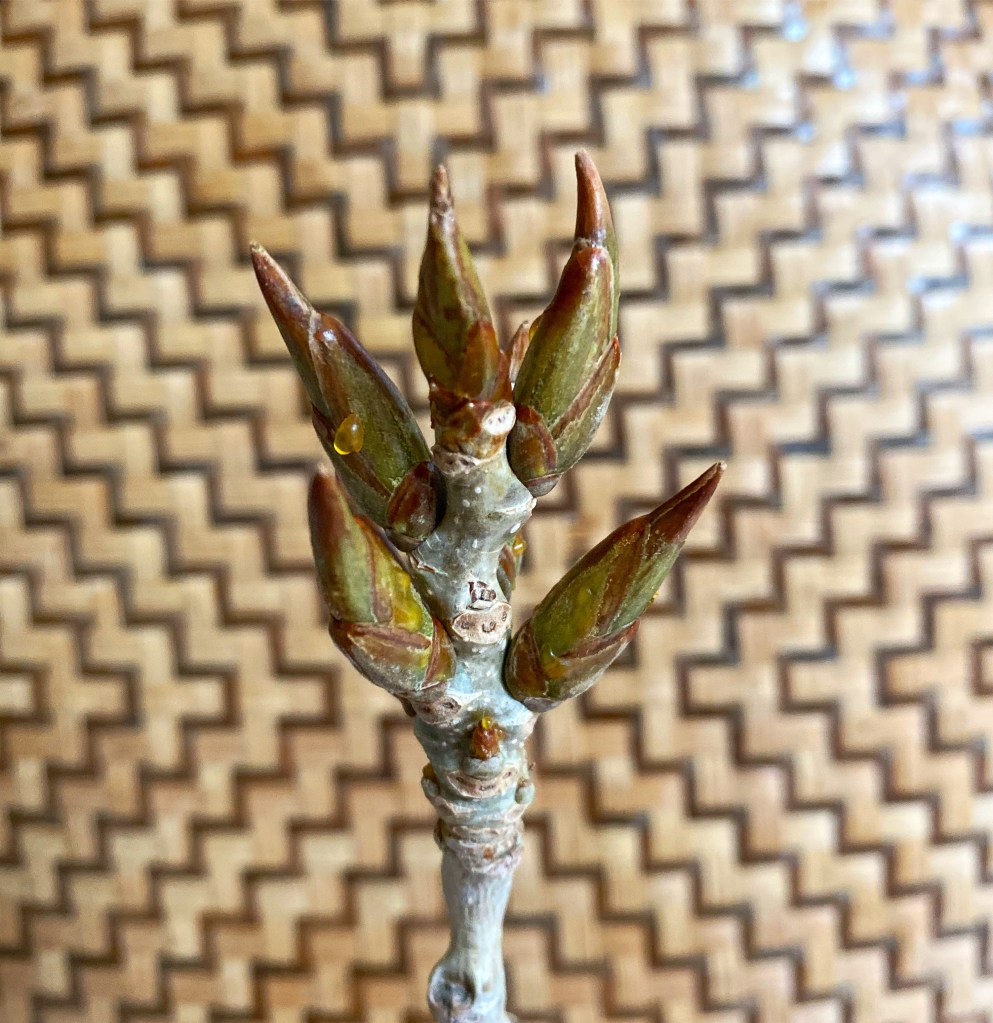
Springtime comes in tight buds ready to burst forth. I mark the shifting season to warmer days with the cottonwood bud harvest. The nearly sickly sweet smell of resin sticking to my fingertips and busy hands tipping bud from stem over and again. I collect them to infuse for six weeks in oil and make salve, otherwise known as Balm of Gilead, it is one of the best all-purpose healing salves made from this prolific and giving tree. Harvesting only from those fallen bits the wind knocks to the ground, I hum to myself (and really to the tree and birds and just-greening grass) sweet little songs of thanks. I feel my hands reverberating motions from times past, connecting me to other wise-women and wortcunning souls that found the inter-connective medicine in relating with the other-than-human world.
I’m not the only one seeking out these juicy buds. I wait for the recent snowfall to melt so I can gather from the six cottonwood sisters in the back acre near our home. Finally, the sun is out, the snow has cleared, and every twig in sight has been carefully cleaned! Fresh deer scat surrounds. If I’m completely honest, my eagerness drops into a frustrated disappointment. My cheeks flush red and I rattle off some expletive comments about the deer. Once the steam of my indignation evaporates, I laugh at myself. What a funny creature, the human, a long history of thinking that anything we see is truly ours for the taking. The next time I visit the cottonwood sisters I bring slices of apples and sing out songs. I know that it will only encourage the deer to return, but if I can invite the wildlife closer to my hearth and heart, I will. If our backyard can be a haven (even with our dog barking guard) then mote it be.
My relationship with the cottonwoods of the front range has deepened every year because of this harvest. When I smell the resin I am transported into the deep-rooted, grounded, and open-hearted energy of this tree. The years when I am too busy or not in close proximity to a cottonwood budding are deeply felt like I’ve missed a friend passing through town and I won’t have another chance to see them for a year. Of course, the cottonwoods are here year round, I can visit them every day if I like. However, the seasonal changes that tether the shifts in temperature and angle of the sun are what pull me along through the year. These altered landscapes buoy me.
I am an altered landscape in my encounters. I am changed when I step outside. I am a shifting form as I age and most lately, in my transition into motherhood. I waxed warm, full, and heavy like the moon when she fills the night and as my belly waned with the baby in my arms, new seasons have penetrated every fiber of my being. I have never loved so much and I have never felt every moment so deeply. New griefs have swelled in me–ones I knew I would meet and others I didn’t realize would crash so heavy. Time slows and stretches around us. I can feel my ancestors around every corner and a sense of hope, safety, and trust that was elusive in my young adulthood where everything felt like it was either behind me or before me and I couldn’t touch a contented joy in the present. Now I feel like the cottonwood tree, strong, full-bodied, grounded, and capable of unlocking reserves of energy and will to overcome any obstacle. More gentle and giving.
I’m also more vulnerable than I’ve ever been. I live in the land of the bittersweet, of the magnificent beauty, and also so aware of how much there is to lose. Too much. And in this process, I allow myself to cut ties, let go of, and peacefully push what no longer serves me onto the current that flows away, like a prayer on a flower floating downstream. I acknowledge what I’ve sacrificed, willingly, of my body, lifestyle, relationships, and career to raise this baby. I’m open to different outcomes on the plans I had previously laid. My body moves differently and my personal practices of ritual, pilgrimage, and daily habits have shifted, some have altogether been released. Some are stronger than ever. Post-fourth-trimester has been a time of editing, reworking my systems of work, creativity, and self-care to include the little one and recover my own creative force.
It’s meant slowing down. Like REALLY going slow and having a very tentative idea of how the day, week, or any moment will unfold. This realization has been an absolute treasure. To actually live the tempo that my body has yearned for, a pace that I imagine most bodies crave. I have picked up and put down the same project days on end with large swaths of time in-between before it is complete. The baby joins me to pick up the fallen cottonwood twigs. A day later I sit beside him while he plays and I break off the buds. He needs me and so I set it aside for days before I finally get them all prepped and into a jar of oil. We set out again to pick up more sticks and days later this next batch of buds is in oil. I strain an infusion and it’s days before I can decant. Piles of laundry remain just so, in piles, clean and not folded. A dye pot sits dirty on the kitchen floor for a week. The vacuum waits next to the couch. The recycling makes it from the kitchen to the doorway and the next day the porch and the next the bin. So many different tasks stringed together by an ever-shifting attention. And I do complete them! Or, I let them go like those ephemeral flowers floating away from me with an “oh, well”. An orderly chaos. A slow, organic medicine.
We weren’t meant to live in the cultural consciousness that has unfolded, the one that says “do more, be more, consume more, prove your worth” and yet so many of us are wrapped up in the race. It’s dangerous to step out of a moving vehicle. It’s all about learning how to fall, how to let go, how to learn what we can give up on, how to utilize timing. It’s a tender and empowering moment, to “give up”. So often that phrase is used in a negative light like you’re not trying hard enough in some way. The other side is acknowledging the harmful pressure of holding on to something that hurts. Or it could be an offering, a raising up. It’s all about the situation and your own needs.
Like the cottonwood tree, I give up pieces of myself and my previous agendas so that they can be transmuted into medicine, into other avenues of life, particularly this little one’s well-being. I drop these extra branches so that I can fully show up. I don’t lose myself in this act of letting go. I’m more complete because of it. I know that whatever I release like compost will be given back to new life.
Elders in the herbal world often say “This is your birthright” when speaking on plant medicine knowledge. It is our birthright and it’s not just physical medicine, it’s a relationship and a way of life to be right with the world. To be along for the ride on the web of life, to know the neighbors (all of them human or not), to bud in the spring, fruit in the summer, harvest in the fall, and rest in the winter. I’ve learned through years of building relationship with the other-than-human world that a slow tempo is the tempo to move by (while still acknowledging there are times to move swiftly and with purpose). It’s a difficult pace to hold when everyone around you seems to be moving constantly and at such high speeds. Generally though, everyone has to take a break. Maybe the slowness can seep into those moments of pause and help reestablish a new rhythm for others to join. All of us are capable of shifting our world through the act of attention. Giving and receiving is a practice of connection and it doesn’t have to look any one way.
My body, my life, my world is an altered landscape, shifting, changing, expanding and contracting in response to the elements it comes in contact with. I’m holding this ephemeral principle so gently in all of its complexity–a wave of bittersweet, tender pain in acknowledging that everything changes. My heart is so full, sticky and swollen like a bud about to burst forth. I drop the burden of branches I no longer need to hold, I sway in my body, and sing with the wind. I pick up new ways of being and move forward season after season.
written by, and will continue to be written by a real, live human and not an AI program
I recognize that the image of a chrysalis is more attractive to people when they are envisioning transformation, but I recently saw a video of a tarantula molt and I was like, “Yeah, that’s how it feels”. Maybe it’s because I’m a scorpio, or maybe it’s that the idea of a chrysalis is both too dramatic and too ‘beautiful’. This isn’t a caterpillar-to-butterfly situation. This is a, “Fuck, I don’t fit in here anymore” situation and I probably won’t appear much different to anyone but DAMN! I sure feel strange. It’s subtle…
When a tarantula molts there’s a tensing up into the body and then an internal force that pushes away out of the old. That internal force is fluid (since, our little spidey friends don’t have muscles and actually move using hydraulics) and they use this to escape from the confines of their former exoskeleton. I LOVE LOVE LOVE the image, although quite simple, that their fluids and blood help them escape the stiff and too small bodysuit they’d been wearing. Elementally, blood makes me think of water and fire together. Emotion and action. Propelled forward through time and space, our blood connects us across a web of history and experience. Sometimes, you just have to get a little emotional, curl up into a ball, and then wriggle yourself out of that old bullshit you’ve been dragging around.
Spiders are quite fragile after they shed their skin and this is typically the time for their growth–in the tender post-molt moments. So, in relating to the fuzzy and oft-times misunderstood tarantula, I don’t quite know what the growth is going to produce, but it was darn-tootin’ time to unzip and joggle my way out. And also, that I feel very tender and it’s probably best if you don’t prod at me right now.
Returning to this idea about BLOOD, it’s exciting to consider how this pulsing element inside us is intrinsically united with our heart, both as a muscle and as an energetic epicenter. We all know how essential blood is so I don’t need to say much about it scientifically, but what is it as something that moors us to a creative force? As an acting element in our bodies intertwined with emotional, physio- and psychological response, it becomes a unique rhythm with which we coordinate around. If your pulse becomes a metronome for interacting with both the inside- and outside-the-body world, what sort of a creative force do you become?
Let me suggest a simple movement exercise: the Molting Tarantula. First, stop whatever you’re doing and take 3 controlled, deep breaths in through the nose out through the mouth. Then, inhale once more as deep as you can while tensing your whole body up and inwards and hold it as long as you can. On the exhale, let any movement that wants to happen escape and wiggle yourself into a dance of your own tempo. Use kinesthetic delight (a term coined by Barbara Dilley) to find yourself in a place of enjoyment balanced somewhere between effort and relaxation. Take as much time as you want to play here and when you’re ready, find a clear ending for yourself in stillness. This is a great time to linger, breathe, and just reflect.
We are using the momentum of our own literal life-force to manifest something in the world. It’s really that simple. And yet, it’s not. We are emotional, changing organisms that are tied up in some pretty complicated systems, some that are indisputably sabotaging our future while simultaneously causing a lot of unnecessary pain to each other (other including the more-than-human). When we are doing our own personal work, the work that’s not shackled to the social or cultural constructs of the world around us, we are doing wyrd work–work tied to our own fate and destiny (etymologically this is an anglo-saxon term–if you don’t like it and it doesn’t resonate with you, please, find one that does and let me know, cause I’m curious). This type of effort in the world can feel pretty strange and some moments can become so intense that we don’t feel like we fit into this world or even our own bodies any more. And this, my dear friend, is when it’s time to shed another exoskeleton and do some more growing.
We can’t shed everything of course. This is the beauty of blood and genetics (and reality), we are tied to our ancestors, to a vibrant history of humanity, and to our own short stories. It’s not all war, bad science, and conquerers. The past, as a whole, is good to remember and to understand, but we create history/herstory/theirstory too, so let’s write something the future will read that we can be proud of. And when you’re feeling lost or confused or frustrated, do the Molting Tarantula and reconnect to your own wild self. Do something creative. Do something relaxing. Do NOTHING. This idea that we have to be ‘productive’ is a myth. Productivity is not a measure of worth. Find the balance. Search for your truth.
Remember we all have our own molting cycles when we need to be left alone so we can reemerge in our own time in our right bodies. Be gentle. Let go of shit. Keep dancing.
Out with the old, in with the new. Happy New Moon! Happy Molting!
P.S. I’d love to hear about your experience with the Molting Tarantula movement exercise if it’s something you so choose to try out.
P.P.S. Since, we are talking about tarantulas and dancing, we can’t avoid bringing up Tarantism–a psychotic-induced impulse to dance supposedly caused by the bite of a specific wolf spider in Italy around the 16th century. There’s no hard evidence to link the spider and the behavior. But, what an interesting image!

 Ephemeral Movement